Contabilizei
Contabilizei
Role:
Senior Product Designer
Year:
2024
Platform:
Web
Team:
Cross-functional (Eng, CS & Tax)
Contabilizei serves thousands of entrepreneurs opening their first company in Brazil. In the first weeks after account opening, many customers felt uncertain about their basic monthly tax routines: how to issue service invoices, how taxes are calculated and paid, and how the owner's salary — known in Brazil as pró-labore, the mandatory salary business owners pay themselves — works. These questions quickly turned into support tickets, creating friction right at the start of the customer journey. As the Product Designer responsible for the project end-to-end, my challenge was to design a web onboarding experience that could educate customers without overwhelming them, personalize the experience through a few profile inputs, and reduce the repetitive support demand around these topics.
Starting from recurring patterns identified with the Support team, I structured the flow around three principles: educate through progressive disclosure and plain language; personalize, generating a tax estimate from the customer's inputs; and drive action, culminating in the issuing of their first service invoice — with an assisted onboarding option for those who preferred guided support. I owned the journey architecture, UI, microcopy, prototyping, handoff, and design QA, in close partnership with CS, tax specialists, and Engineering. The flow reduced support calls related to the covered topics by 30%, freeing the support team to focus on more complex issues and helping customers begin their journey with greater clarity and confidence.
Contabilizei serves thousands of entrepreneurs opening their first company in Brazil. In the first weeks after account opening, many customers felt uncertain about their basic monthly tax routines: how to issue service invoices, how taxes are calculated and paid, and how the owner's salary — known in Brazil as pró-labore, the mandatory salary business owners pay themselves — works. These questions quickly turned into support tickets, creating friction right at the start of the customer journey. As the Product Designer responsible for the project end-to-end, my challenge was to design a web onboarding experience that could educate customers without overwhelming them, personalize the experience through a few profile inputs, and reduce the repetitive support demand around these topics.
Starting from recurring patterns identified with the Support team, I structured the flow around three principles: educate through progressive disclosure and plain language; personalize, generating a tax estimate from the customer's inputs; and drive action, culminating in the issuing of their first service invoice — with an assisted onboarding option for those who preferred guided support. I owned the journey architecture, UI, microcopy, prototyping, handoff, and design QA, in close partnership with CS, tax specialists, and Engineering. The flow reduced support calls related to the covered topics by 30%, freeing the support team to focus on more complex issues and helping customers begin their journey with greater clarity and confidence.
-30%
-30%
Fewer support calls on the topics covered by the flow
Fewer support calls on the topics covered by the flow

A personalized tax estimate, generated from three inputs. The moment the onboarding stops explaining and starts working for the customer.
A personalized tax estimate, generated from three inputs. The moment the onboarding stops explaining and starts working for the customer.
A personalized tax estimate, generated from three inputs. The moment the onboarding stops explaining and starts working for the customer.


Progressive disclosure in practice: each monthly routine gets one short, plain-language screen instead of a single dense page. Customers learn the cycle before they're asked to act on it.
Progressive disclosure in practice: each monthly routine gets one short, plain-language screen instead of a single dense page. Customers learn the cycle before they're asked to act on it.
Revenue scenarios
Revenue scenarios
A few questions, high leverage: revenue and profile inputs power the personalized estimate ahead — so every field had to justify its presence.
A few questions, high leverage: revenue and profile inputs power the personalized estimate ahead — so every field had to justify its presence.


Tax estimate
Tax estimate
Tax jargon stays out of the way. Terms like INSS and pró-labore are explained in tooltips, on demand — keeping the main flow readable for first-time business owners.
Tax jargon stays out of the way. Terms like INSS and pró-labore are explained in tooltips, on demand — keeping the main flow readable for first-time business owners.
Monthly salary adjustment
We calculate it for you to maximize savings. On the 7th of each month, the amount is available in the platform for you to review.
DAS Simples
DAS Simples is calculated based on your revenue. It bundles multiple federal taxes into a single payment.
DARF
It includes two taxes: INSS and IRRF. INSS contributes to your retirement and other social security benefits. IRRF applies to owner’s salary.

Customization
Customization
Customization
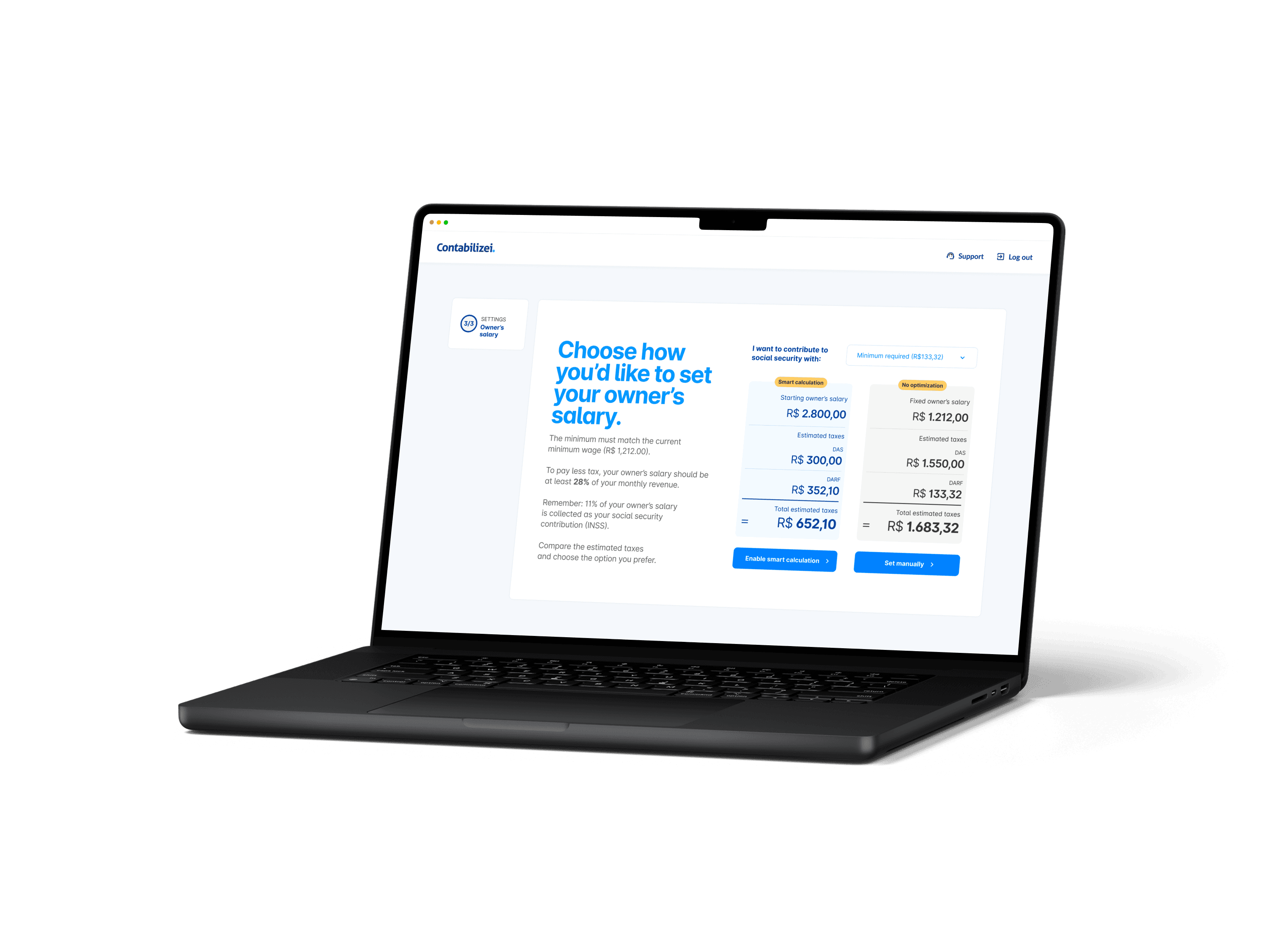
Smart calculation by default, manual control on demand. In a tax product, showing the math — minimum, maximum, and custom amounts — is what builds trust in the automation.
Smart calculation by default, manual control on demand. In a tax product, showing the math — minimum, maximum, and custom amounts — is what builds trust in the automation.

Enable smart calculation
Enable smart calculation
Enable smart calculation

Set manually
Set manually
Set manually
The flow ends in action, not theory: customers issue their first service invoice right away — with an assisted path available for those who prefer guided support.
The flow ends in action, not theory: customers issue their first service invoice right away — with an assisted path available for those who prefer guided support.

Learnings
Learnings
If I were iterating further, I’d expand funnel instrumentation: completion rate, drop-offs by step, time to complete and test variations of copy and sequencing. I’d also tailor content more dynamically based on customer profile and business activity, so guidance feels even more relevant.
If I were iterating further, I’d expand funnel instrumentation: completion rate, drop-offs by step, time to complete and test variations of copy and sequencing. I’d also tailor content more dynamically based on customer profile and business activity, so guidance feels even more relevant.


